There’s a tension sitting in education right now. We tell students to be adaptable. We encourage them to embrace change. We remind them constantly that the future will look nothing like today. Then artificial intelligence enters the picture, and many of us instinctively respond with hesitation. We restrict it. We warn against it. We build policies around it. Underneath it all is a quiet fear of losing control. But if we are honest, the deeper issue is discomfort. AI is exposing how quickly the world is moving and how easy it is for schools to stand still.
Education has always had a rhythm.
Same curriculum.
Same projects.
Same assessments.
Semester after semester.
There is comfort in that predictability. It feels safe. It feels proven. Yet safety can quietly become stagnation. When something works, we tend to preserve it. But our students are not the same students from five years ago, and the world they are entering is radically different. Businesses are integrating AI into daily workflows. Community organizations are exploring automation and creative augmentation. The pace of change is accelerating, and AI is not waiting for our lesson plans to catch up.
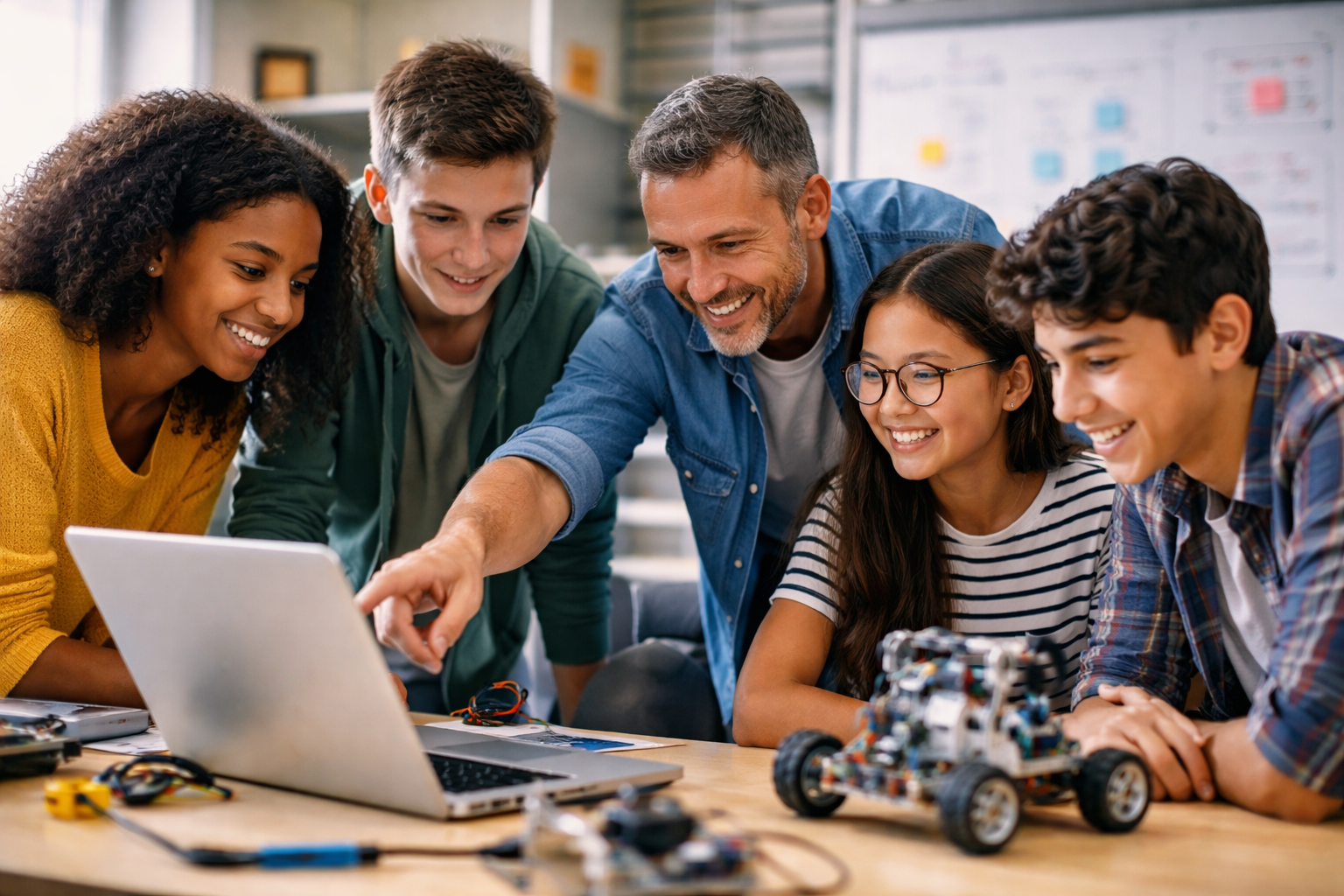
The real question is not, “How do we stop students from using AI?” The better question might be, “How do we grow with them?” Over more than two decades in education, what has kept me energized has not been content mastery alone. It has been curiosity. It has been the willingness to say, “Let’s figure this out together.” When a new tool emerges, the most powerful move is not to become the gatekeeper but the co-learner. When students see you experimenting, testing, questioning, and refining in real time, they witness what lifelong learning actually looks like.
AI is not just a technology conversation. It is a mindset conversation. If we treat it like a threat, students will use it in secret. If we treat it like a thinking partner, they will learn to use it responsibly. When we say, “Let’s test this. Let’s break it. Let’s critique it,” we move from fear to framework. Suddenly, AI becomes something to evaluate rather than something to avoid. Students can compare its output to their own reasoning. They can analyze bias. They can refine prompts as a communication skill. They can ask, “Where does human insight outperform machine efficiency?”
That is deeper learning.
The opportunity becomes even more powerful when we connect AI to real community needs. Imagine students partnering with local businesses to solve authentic challenges, using AI as one tool in a broader problem-solving process. Now it is not about shortcuts or cheating. It is about capability. It is about ethical reasoning, collaboration, creativity, and critical thinking. When learning intersects with real organizational needs, motivation shifts naturally. Students are no longer completing assignments. They are contributing.
This moment is asking something of us as educators. It is asking us to model the adaptability we expect from our students. We cannot say, “Be resilient,” while resisting change ourselves. We cannot promote lifelong learning while clinging to laminated curriculum.
AI is not the disruption. It is the mirror. It reflects whether we are willing to evolve.
The educators who will thrive in this era are not the ones with all the answers. They are the ones willing to say, “I’m learning this too.” They are the ones who invite feedback from students and industry. They are the ones who redesign instead of restrict. Because in a world where information is instant, the real skill is not access to answers. It is the ability to think, adapt, and grow.
If we expect students to stretch, we must stretch first. If we want them to navigate uncertainty with confidence, we must show them how. In the age of AI, learning to learn is no longer optional. It is essential. And the only way to truly teach it is to live it alongside them.

Peter Hostrawser
Creator of Disrupt Education
My value is to help you show your value. #Blogger | #KeynoteSpeaker | #Teacher | #Designthinker | #disrupteducation